





Things are looking rather bleak for the economy and stock market right now.
Following a rough April for stocks, continuing high prices for, well, everything, and the surprise pullback in U.S GDP for the first quarter of 2022, it’s no wonder people are concerned.
Many are saying the U.S is on the verge of a recession, thanks to slowing growth, inflation, and rising interest rates. After a strong economic resurgence coming out of the pandemic, things are now starting to look shaky, indeed.
While there are no indicators that predict with 100% accuracy what is going to happen with the economy and the stock market, there is one indicator that has a pretty good track record of forecasting recessions: the yield curve. According to the Federal Reserve of Chicago, the yield curve has foreshadowed every U.S recession since 1970.
Unfortunately, the yield curve recently flashed warning signs when it “inverted” in March 2022 for the first time since 2019.
With so much economic negativity and speculation, you might be wondering what you should do and if you can prepare for a recession. Let’s walk through some basics and potential ideas.
What is “yield”?
In the financial world, yield can mean several things, but in this case, it represents the amount that is paid out by a bond divided by the bond’s price. It’s basically a measure for how much a bondholder is getting paid for holding the bond, relative to how expensive the bond is at a given time.
The higher the yield, the more money you, as the bondholder, make per dollar of bond. Yields fluctuate up and down based on the supply and demand for bonds and the interest rates set by the central bank.
Read more: How to buy bonds: investing in bonds made easy
What is the yield curve?
The yield curve is a graphical representation of the yields on U.S government bonds (or U.S treasuries) that come due at different times.
A treasury is U.S government debt, created when the government borrows money from investors. Think of it like a loan the government is taking out.
Since the government has different funding needs, it takes out these loans over many time horizons (terms). The longer the time horizon, the higher the yield on the bond should be to compensate investors for tying their money up for so long.
Long-term bonds are riskier than short-term bonds because the price of the long-term bond is more impacted by moves in interest rates.
In normal times, the yield curve slopes up and to the right, noting investors are being compensated for taking longer-term risks.
In recessionary times, the yield curve “inverts” and short-term bonds have higher yields than longer-term bonds. This means that investors are not being compensated for longer-term risks.
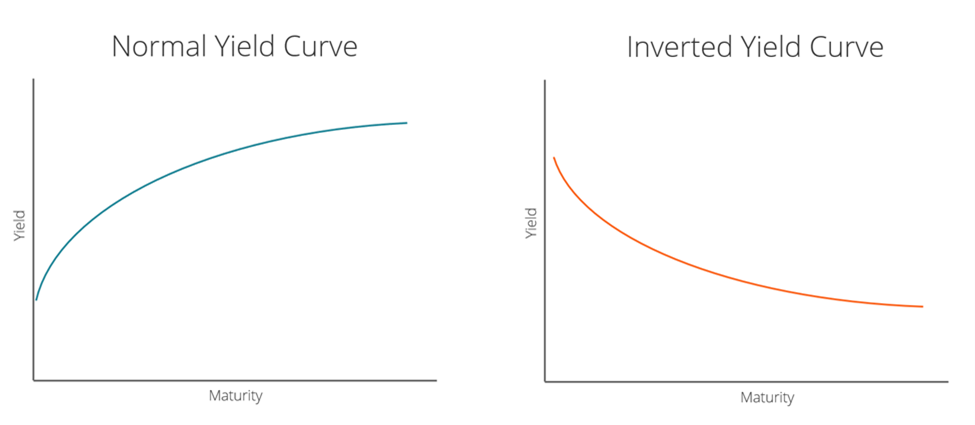
Source: Corporate Finance Institute, screenshots by Aubrey Chapnick
Yield curves can also be visualized by subtracting the yield of longer-maturity U.S treasuries by the yield on shorter-maturity treasuries. If a negative number is generated (meaning the shorter-maturity yield is higher than the longer-maturity yield), an inversion has occurred.
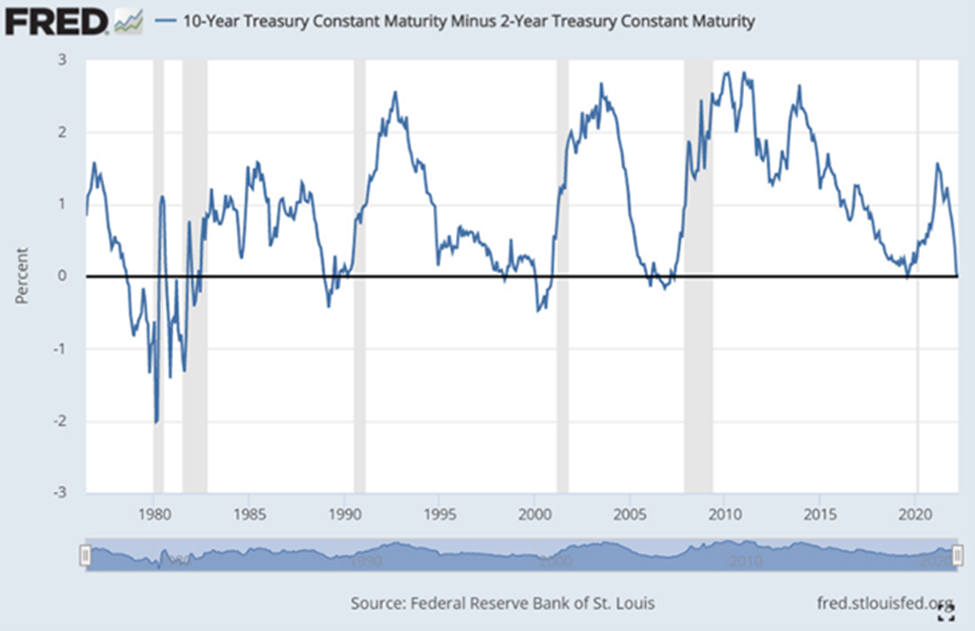
Source: Federal Reserve Bank of St. Louis, screenshot by Aubrey Chapnick
While there are many types of yield curves, one of the most followed and important yield curves is the 2-year/10-year curve (above).
The 3-month/10-year yield curve is also a closely followed recession indicator.
How does the yield curve predict recessions?
While nobody knows exactly why the yield curve is such a good recession predictor, it does shed light on how investors feel about risk and the overall willingness of financial institutions to lend money.
When long-term yields are higher than short-term yields, banks and other financial institutions are incentivized to lend. This is because banks lend out deposits (short-term funding) as mortgages, car loans, personal loans, lines of credit, etc., which are done on a longer-term basis. Such differences, or “spread,” is how banks make most of their money.
If, however, the costs of their short-term funding exceed the amount they can make on their long-term lending, banks stop lending money — and the economy contracts.
This is one of the many (most simplistic) reasons why yield curve inversions infer a coming recession.

Source: Giphy.com
Should you sell everything if the yield curve inverts?
While the yield curve has a strong track record for predicting bad economic times ahead, you shouldn’t make any rash decisions when there’s an inversion.
Firstly, an inversion must be sustained for it to predict an upcoming recession. Sometimes there are day-long inversions that can spook investors, but those don’t have the same kind of predictive power as more sustained inversions.
Secondly, it takes a certain amount of time following a yield curve inversion for a recession to take place. Historically, it’s taken between six and 24 months for a recession to emerge following a 2-year/10-year inversion.
Read more: How to prepare for a recession
Thirdly, while a yield curve inversion has been a good economic recession predictor, it hasn’t always been a good predictor of stock returns plummeting overnight. The average return of the S&P 500 in the 12 months following a 2-year/10-year inversion has been 7.4% since 1978 and 1.4% for the 3-month/10-year.
If you want to take more than just my word for it, listen to finance legends Eugene Fama and Ken French. They explored the relationship between yield curve inversions and stock returns and found there is no evidence that inverted yield curves predict stocks will underperform treasury bills for forecast periods of one, two, three, and five years.
Given all these factors, it would be very difficult to make consistent and reliable decisions with your portfolio based solely on the yield curve inverting.
Read more: How to create an inflation-proof portfolio
How to prepare when the yield curve inverts
Now that you understand what the yield curve is and why it matters, there are things you can do with your finances to get prepared if things start to look iffy.
Save more
Since the yield curve is a strong predictor of an economic recession, it would be wise to start saving more if you hear that it has inverted.
And since a recession typically comes with job losses, it is never a bad idea to start building an emergency fund in case your job is at risk. Given the time lag between an inversion and a recession, this should provide you with a good buffer to build a safety net.
Related: Emergency funds: everything you need to know
Don’t try to time the market
If you’re reading this article, you probably already know it’s a bad idea to try to time the market.
Remember: yield curve inversions are a difficult measure to judge future immediate stock returns, so don’t think that just because you’ve observed one, it’s time to sell everything or begin shorting the market.
Stay the course
Although a yield curve inversion might signal an impending recession, the good news is that, historically, recessions aren’t very long on average.
According to Capital Group’s analysis of the 10 past business cycles since 1950, recessions have lasted between eight and 18 months, with the average spanning about 11 months.
In the face of this type of adversity, the best thing you can do for your portfolio is stay calm and keep a long-term perspective.
Featured image: Sophon Nawit/Shutterstock.com
Read more: