





As an investor, you’ve probably strongly considered diversifying your stock portfolio with some commercial real estate (CRE) if you haven’t already. After all, CRE investments are significantly more stable than cryptocurrency and can offer more options and better upside than residential investments.
However, the challenge with CRE investments has always been in the initial search. Given countless variables like cyclical markets, sector stagnation, and developer reputations, finding the right opportunity can be like finding a needle in a stack of needles.
Since Congress eased securities regulations through the JOBS Act in 2012, many online real estate investment marketplaces have emerged. Though these platforms lend convenience, many investors feel that they actually increase risk by introducing special purpose vehicles (SPVs), which can disrupt the flow of funds and information.
Plus, the scope of these platforms can lead to quality control issues. In short, many are choked with unscrupulous fix-and-flip “opportunities.”
If you’re looking into CRE investing, you’d ideally have a platform devoted solely to CRE, with pre-screened opportunities, ways to connect directly to project sponsors, and even access to a mutual fund.
That’s where CrowdStreet comes in.
What is CrowdStreet?
Founded in 2014 in Portland, OR, CrowdStreet connects accredited investors to pre-screened commercial real estate investment opportunities.
CrowdStreet is an intermediary, not a special purpose vehicle (SPV). This means that while they do take a small cut, they empower you to connect directly with project sponsors. As mentioned above, this is a big deal because SPVs can cause communication issues or delayed funding. CrowdStreet gives you the freedom to manage your own relationship with your project sponsor.
Although CrowdStreet offers the market’s largest number of investment offerings at any given time, don’t let that fool you into thinking it trades quantity for quality. First, CrowdStreet is strictly commercial-only: there are no residential or fix-and-flip opportunities here.
Second, its sponsor vetting process is rigorous, to say the least — including background checks, reference checks, and more. The acceptance rate speaks for itself: only 5% of deals reviewed qualify for CrowdStreet.
How does investing with CrowdStreet work?
You can begin investing with CrowdStreet in three quick steps:
- Create an account.
- Complete your investor profile.
- Browse deals and invest.
There are two noteworthy elements of the account creation process.
First, if you’d like to browse deals before committing all of your information, CrowdStreet lets you begin the browsing process as soon as you enter just your name, email, and password.
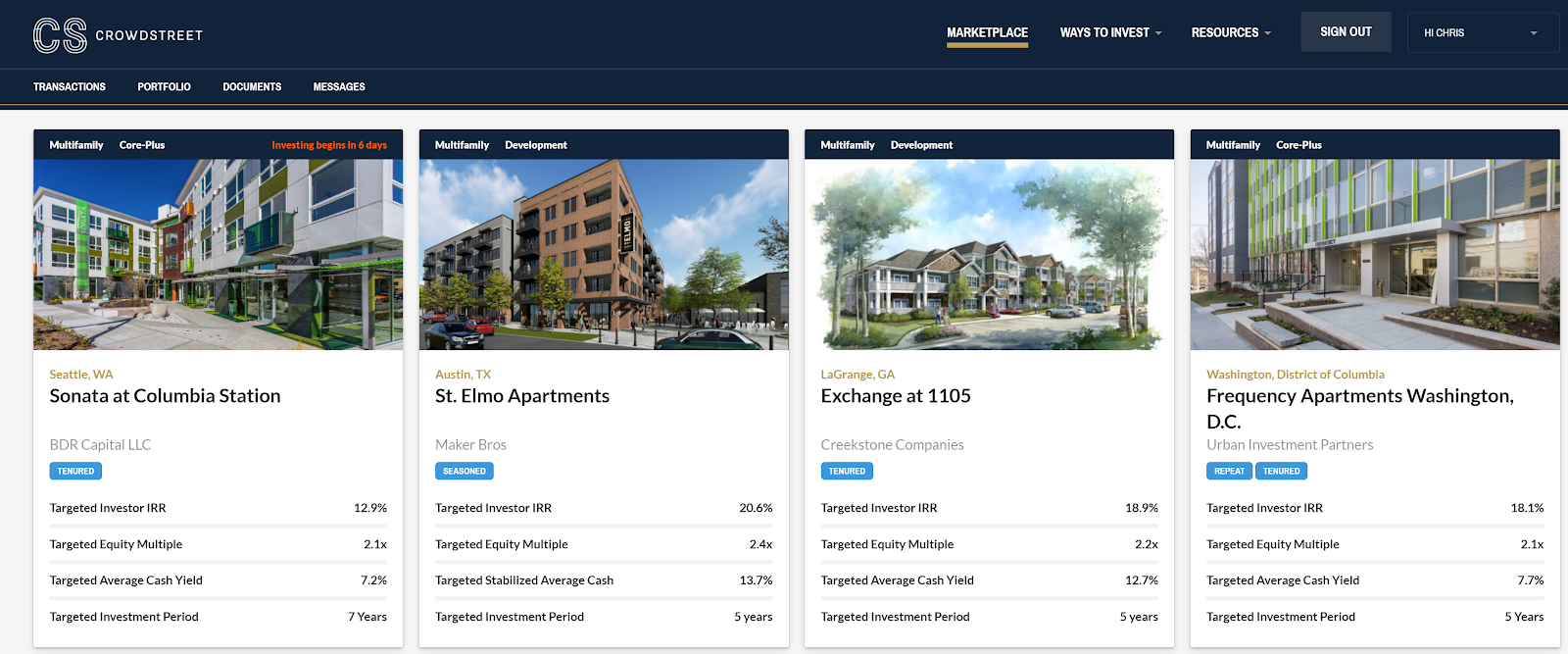
You can begin browsing CrowdStreet deals as soon as you create a basic account | Source: CrowdStreet, screenshot by Chris Butsch
Second, CrowdStreet will ask you multiple times to confirm whether you’re an accredited investor or not. But more on that in a bit.
Once you begin browsing deals you’ll discover how easy it all is. As a potential investor about to plunk down new car money, all of the information you could possibly want on a given deal is cleanly presented, including:
- Photo and video.
- Key deal points.
- The business plan.
- The capital stack.
- Live webinar invites and recordings.
- Essential documents.
- Site plan, unit plans, amenities, etc.
- Sponsor info with track records.
- Q&A forms.
- And more.
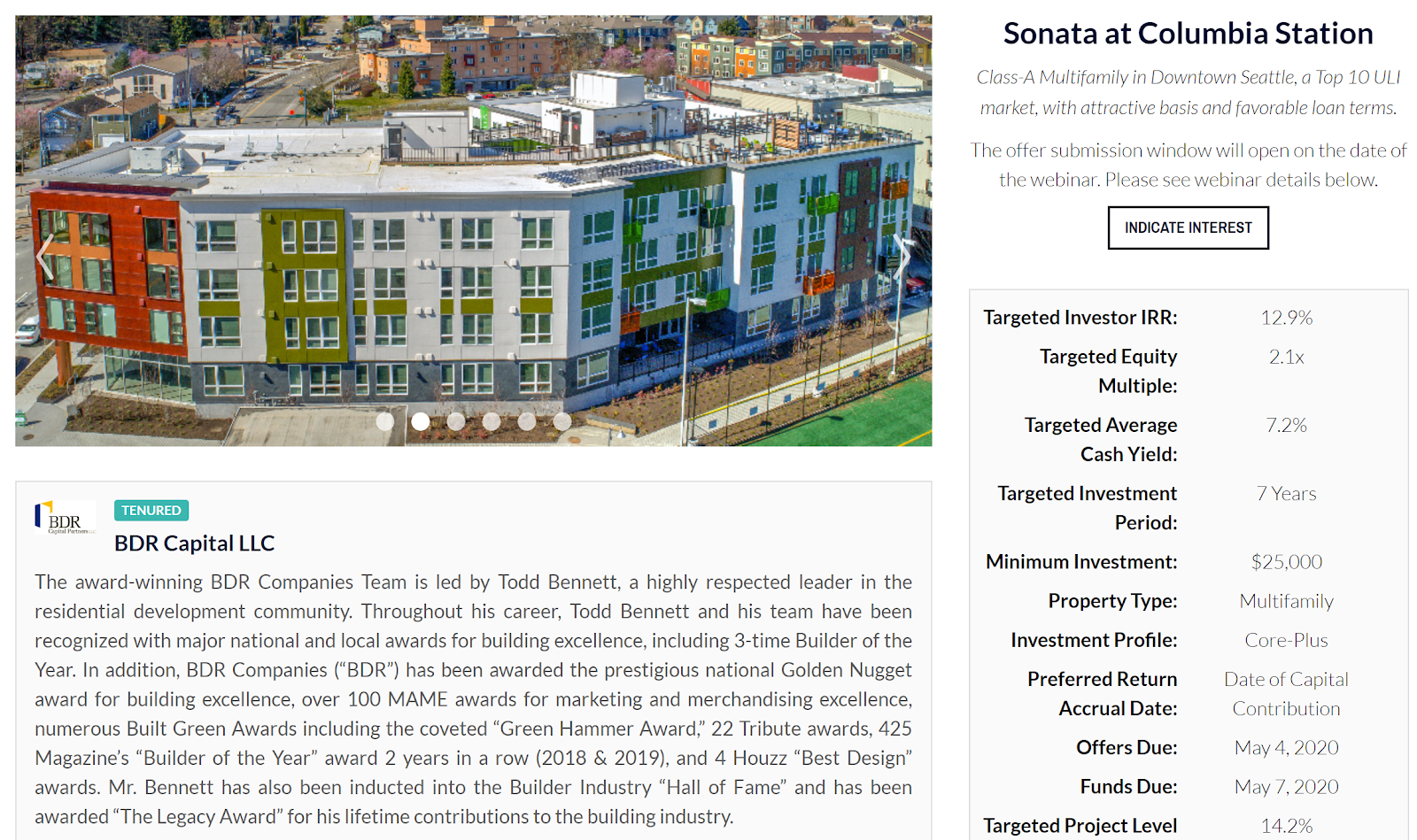
You’ll find essential deal information at the top like sponsor info and minimum investment | Source: CrowdStreet, screenshot by Chris Butsch
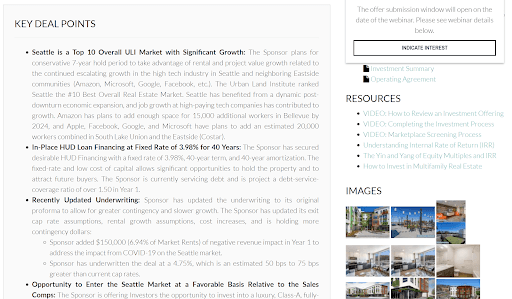
Below you’ll find a deal summary and a plethora of additional resources | Source: CrowdStreet, screenshot by Chris Butsch
In short, CrowdStreet organizes an astonishing level of information for each deal it posts in a crisp and clean manner.
CrowdStreet has clearly met the Herculean task of simplifying the commercial real estate investment process. The site is astonishingly robust and easy to use, so much so that other crowdfunding or investment platforms could learn a lot from it.
So why did CrowdStreet ask if I’m an accredited investor?
Accredited investors are persons, entities, or funds that meet certain requirements for net worth and thus have access to greater investment opportunities. The SEC created accreditation to protect less wealthy and experienced investors from high-risk opportunities.
To qualify to the SEC as an accredited investor you must meet at least one of the following criteria of personal wealth:
- Have individual net worth, or joint net worth with a spouse, that exceeds $1 million (excluding the value of your primary residence).
- Have individual income exceeding $200,000 in each of the past two years, and expect to reach the same this year.
- Have joint income with a spouse exceeding $300,000 in each of the past two years, and expect to reach the same this year.
- Invest on behalf of a business or investment company with more than $5 million in assets and/or all the equity owners are accredited.
A non-accredited investor is simply a person or entity that doesn’t meet the above criteria, and thus has lesser access to fewer investment opportunities.
What does CrowdStreet offer both types of investors?
Very generally speaking, accredited investors get access to CrowdStreet’s full offerings, including single property offerings, funds, and their own product, The Blended Portfolio (details below in Features).
Non-accredited investors have access only to certain properties or funds.
How much does CrowdStreet cost?
Account creation is free. CrowdStreet charges a 0.5% to 1% management fee for its investment vehicle, the CrowdStreet Blended Portfolio.
Fees for all other offerings not from CrowdStreet vary depending on the deal and are displayed on each offering detail page.
What are CrowdStreet’s best features?
Among other real estate investment platforms, what are CrowdStreet’s standout features?
Commercial real estate investments
With CrowdStreet, you can invest in a variety of projects in the commercial real estate market, including office buildings, retail centers, and multifamily properties. CrowdStreet makes it easy to diversify your commercial real estate portfolio and access a variety of investment opportunities. Best of all, you can start investing with as little as $25,000.
Connect directly with sponsors
I’ve mentioned it twice but it’s still worth reiterating: CrowdStreet is not a specialty purpose vehicle (SPV). SPVs are effectively investment middlemen that may provide convenience, but introduce a layer of risk via possible marketplace insolvency or delayed funding.
Eschewing trends, CrowdStreet connects investors directly to project sponsors for a much smoother process.
Institutional-quality offerings
CrowdStreet does not offer residential or fix-and-flip opportunities. They eliminate 95% of their developer applications through a thorough screening process including reference and background checks. What you see is of superior quality; CrowdStreet is more Costco than Walmart.
Not every deal will be right for you, but CrowdStreet doesn’t ask you to blindly trust them and roll the dice with a five-figure investment. Offerings are both high-quality and transparent.
The CrowdStreet Marketplace
You can create an account and begin browsing CrowdStreet’s curated deals within seconds. Furthermore, the site is superbly well laid out and easy to use. Plus, if you need extra assistance, it’s easy to find. You can schedule a call with investor relations or visit the help center from the Resources dropdown menu.
It’s hard to poke holes in CrowdStreet as a platform because it’s solid as granite. Its only major “fault” (and it’s abundantly self-aware of this), is that it’s highly exclusive. But I’ll get to that.
The CrowdStreet Blended Fund
Interested in diversifying your portfolio with commercial real estate but lacking the time (or patience) for due diligence on each potential deal? Consider investing in the CrowdStreet Blended Portfolio (CSBP) — known as the “Blended Fund.”
The CSBP consists of 25+ real estate offerings from within the CrowdStreet Marketplace chosen by a proprietary algorithm, which keeps a diverse mix of property types, risk profiles, and geographies.
Who is CrowdStreet ideal for?
High-net-worth individuals looking to diversify their portfolio
CrowdStreet isn’t shy about its offerings and whom they’re for. And a peek at their featured offerings reveals that they want clients who can make illiquid investments of five-plus years.
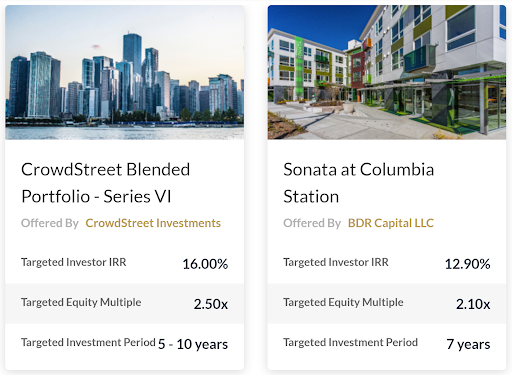
Source: CrowdStreet, screenshot by Chris Butsch
There’s really no other buyer profile to put in this section. CrowdStreet’s ideal client is an accredited investor who can invest at least $25,000 into a commercial real estate deal and forget about it for at least five years.
If that doesn’t sound like you, however, you can still benefit from the platform. It’s just not ideal for you.
Those who want exposure to the commercial real estate market
Commercial real estate investing platforms like Crowdstreet offer a unique opportunity for investors to get exposure to the real estate market.
By pooling together capital from a large number of investors for a single real estate investment, crowdfunded real estate platforms are able to finance projects that would otherwise be out of reach for individual investors. Furthermore, these platforms offer a high degree of transparency, allowing investors to see exactly where their money is going.
Perhaps most importantly, by investing in commercial real estate through a platform like Crowdstreet, investors can avoid many of the traditional hassles and headaches associated with real estate investing, such as property management and lease negotiation.
For all these reasons, most real estate investors will like Crowdstreet, as it can be an attractive option for those looking to get quick exposure to the real estate market.
People who want direct exposure to real estate companies
For real estate investors who want direct exposure to real estate professionals, Crowdstreet is a great platform. It offers real estate deals in a variety of asset classes, from office buildings and shopping centers to apartments and storage units.
And because it’s an online marketplace, it’s easy to find and compare deals. Plus, you can invest as little or as much as you want in each deal. So if you’re looking for a way to get direct exposure to real estate developers, Crowdstreet is worth checking out.
Who is CrowdStreet not ideal for?
Short-term investors
CrowdStreet’s average Target Investment Period is five years. There are deals with TIPs as short as two years, but these deals might not provide the high returns of a longer-term CRE investment. If you’re looking for quick in-and-out so you can reinvest elsewhere, CrowdStreet (and CRE in general) might not be for you.
Low-net-worth investors
The minimum buy-in amount for a deal on CrowdStreet’s platform is $25,000.
That being said, CrowdStreet has had a handful of Regulation A+ deals that were open to non-accredited investors over the years. So, if you’re a non-accredited investor you may still have options to invest through CrowdStreet, just fewer.
Investors seeking liquid options
As you’ve probably surmised, commercial real estate deals are highly illiquid. Even with the direct relationship that CrowdStreet provides, it’s highly difficult — often impossible — to pull cash out of a CRE investment, especially one with a lengthy Target Investment Period (TIP).
You should only invest money into CRE that you don’t think you’ll need for a long, long time. If you’re ready to invest a large amount but lengthy TIPs of five to 10 years intimidate you, consider further diversifying your stock portfolio or investing in money market funds instead.
Those who’d prefer an investment advisor
There are a number of reasons why Crowdstreet is not a good fit for those who would prefer to work with a registered investment advisor.
Keep in mind that registered investment advisors are required by law to act in their clients’ best interests. This fiduciary duty ensures that registered investment advisors will always put their clients’ interests first when making investment decisions. Additionally, registered investment advisors are required to have a deep understanding of their client’s financial goals and needs before recommending any investments.
By contrast, Crowdstreet does not require its users to undergo any sort of financial assessment before investing. As a result, users of Crowdstreet may end up investing in projects that are not suited to their needs or goals.